
Why People Search for “Mannor Reviews”
When people type “Mannor reviews” into Google, they’re usually not looking for opinions like “pretty jewelry” or “nice packaging.”
They’re trying to calm a very specific internal dialogue.
Is this a real brand?
Are these real moissanites?
Am I missing something important?
That’s especially true in the moissanite world.
Moissanite buyers tend to be more analytical than classic diamond buyers. They ask sharper questions:
- Are Mannor moissanites lab-created or just simulants?
- What kind of certification do they come with?
- Is Mannor Jewelry (mannorjewelry.com) an actual jewelry business – or just good visuals and storytelling?
And in Mannor’s case, the curiosity is understandable.
The brand operates out of Egypt – a country with a deep jewelry tradition, but one that many international buyers don’t fully understand. Combine that with moissanite – a gemstone still surrounded by myths – and extra due diligence feels natural.
The problem is that most Mannor Jewelry reviews online don’t really answer these questions.
They talk about delivery speed.
They talk about how the piece looks.
They talk about emotions.
All of that is fine – but it doesn’t explain what you’re actually buying.
And for moissanite, surface impressions are never enough.
What Is Mannor Jewelry
At its core, Mannor Jewelry is a jewelry brand based in Egypt, operating through physical retail stores, showrooms, and an online platform.
That matters more than it sounds.
Egypt has a long-standing culture of in-store jewelry buying. Customers expect to see stones up close, compare sparkle in real light, ask uncomfortable questions, and walk away if something doesn’t feel right.
Brands that survive in this environment usually work with real inventory, not abstract listings or borrowed photos.
Mannor fits that reality.
Another important point – Mannor is not “trying moissanite.”
Moissanite is not a side experiment here. It’s a core material.
The brand works with:
- finished jewelry (rings, earrings, bracelets),
- and loose moissanite stones, which is something only confident sellers usually do.
From an expert perspective, loose stones are telling.
There’s nothing to hide behind a setting – cut, symmetry, and fire are immediately visible.
Mannor’s Product Range: Seen Through a Moissanite Lens
From a moissanite expert’s point of view, Mannor’s assortment feels deliberate, not random.
Loose moissanite stones play a central role. These are lab-created moissanites, supplied with standard moissanite certificates (GRA / GLV-type formats), which is normal practice in the global market.
Important to understand:
These certificates are not about investment value.
They exist to confirm what the stone is, not to mythologize it.
Beyond loose stones, Mannor produces finished jewelry:
- rings (including engagement-style designs),
- earrings (mostly studs and everyday formats),
- bracelets – especially tennis-style designs, where cut consistency becomes obvious very quickly.
The metals used – gold and silver alloys common in modern jewelry – make sense for moissanite. They don’t compete with the stone’s fire, they support it.
Design-wise, Mannor stays in modern-classic territory. Clean proportions, balanced settings, no unnecessary drama. That’s usually a sign of a brand that understands how moissanite behaves in real life, not just in studio lighting.
Mannor Moissanites: What These Stones Actually Are
Let’s clear one thing up properly.
Mannor uses lab-created moissanite – which is not a compromise, and not a shortcut.
In the global jewelry market of 2020–2025, lab-created moissanite is the standard. Natural moissanite exists, but not in quantities suitable for jewelry production. Any serious moissanite brand today works with lab-created stones.
What matters is not origin – but performance.
For moissanite, three things define quality:
Cut
Moissanite has a higher refractive index than diamond. A bad cut exaggerates flaws. A good cut creates controlled, elegant fire.
Clarity & symmetry
Moissanite doesn’t follow diamond grading strictly, but internal cleanliness and optical balance still matter – a lot.
Behavior in real light
Daylight, indoor lighting, movement. This is where moissanite either looks magical – or cheap.
Well-cut moissanite doesn’t try to “pretend” it’s a diamond.
It has its own optical signature – more fire, more dispersion, more life.
Calling it a “fake diamond” is simply incorrect.
Certificates and Authenticity: No Myths, No Drama
Moissanites sold by Mannor come with standard moissanite certificates (GRA / GLV-type).
These certificates do one job – and they do it well.
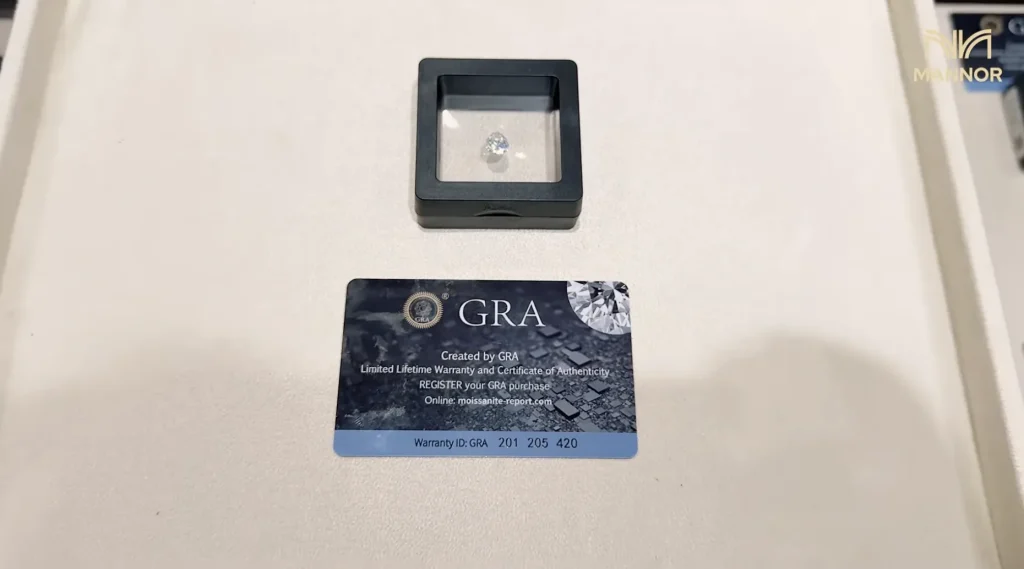
They confirm:
- the stone is moissanite (not glass, not cubic zirconia),
- basic characteristics like shape, size, cut style,
- an identification reference.
They do not:
- promise investment returns,
- claim rarity,
- assign speculative value.
And that’s exactly how it should be.
Moissanite is a lab-created gemstone with predictable properties. Diamond-focused systems like GIA are simply not the industry standard here – and don’t need to be.
For experienced buyers, certification is a baseline.
The real judgment starts when you look at the stone itself.
Cut Quality and Real-Life Appearance
Ask any moissanite specialist what matters most and you’ll hear the same answer:
Forget the paper. Look at the stone.
Cut quality defines everything.
Well-cut moissanite shows:
- controlled fire (not chaotic rainbow flashes),
- even brilliance across the surface,
- sparkle that works in motion, not just under spotlights.
From what’s visible in Mannor’s stones – both loose and set – the cuts are chosen for real-life performance, not just size on paper.
That’s why many Mannor reviews, even short ones, repeat the same phrase:
“It looks better in real life.”
A Note on MoneyBack
One thing that often surprises people – and is worth mentioning briefly – is that moissanite products within Mannor are associated with the highest MoneyBack potential in the brand’s structure.
Not because of hype.
Not because of promises.
But because moissanite production is more efficient and predictable than diamonds, which allows different internal loyalty mechanics.
This article is not about that system – and intentionally so.
If you’re curious about how moissanite jewelry can combine visual value with structured MoneyBack logic, that topic is explored in detail in a separate piece:
Here, we stay focused on the stones themselves.
Presentation, Show, and Brand Feel
Mannor clearly understands one important thing:
Moissanite needs context.
Lighting, angles, movement – all of it matters. That’s why the brand invests heavily in presentation:
- in-store vitrines designed for sparkle,
- individual packaging,
- consistent visual language online,
- showroom-style content instead of random catalog shots.
This is the difference between selling a stone and selling confidence.
Mannor’s physical stores in Cairo and Sharm El Sheikh, along with expansion across Egypt, support that idea. These aren’t temporary setups – they’re spaces built for comparison, education, and trust.
Team, Scale, and Long-Term Intent
Behind Mannor is a structured team approach:
- jewelry specialists,
- moissanite consultants,
- trained customer support,
- internal education systems.
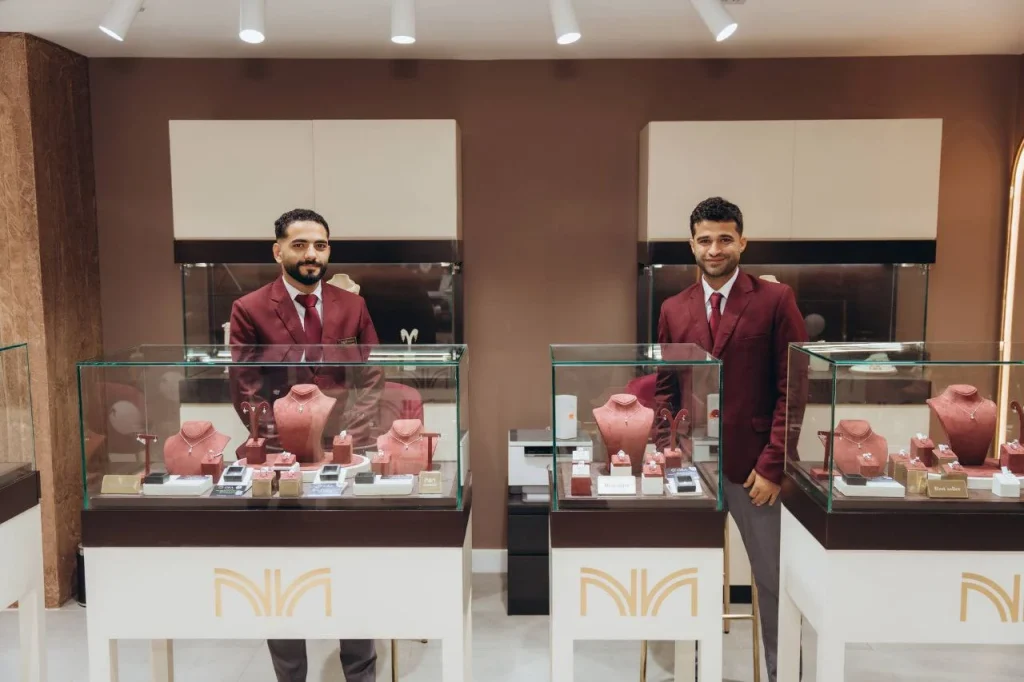
This becomes especially important when a brand sells both loose stones and finished jewelry. Different buyers ask different questions – and Mannor appears built to handle that.
On a larger scale, Mannor International supports global expansion, with partners in 40+ countries and tens of thousands of participants worldwide.
That level of organization doesn’t appear by accident – and rarely belongs to short-lived projects.
Final Thought
If you’re reading Mannor Jewelry reviews trying to decide whether the brand is “real”, the answer doesn’t live in comments.
It lives in:
- the stones,
- the cuts,
- the certification logic,
- the presentation,
- and the structure behind the brand.
Once you understand those, most doubts disappear on their own.
And that’s usually the best kind of review there is.