An honest conversation – no showroom glass, no sales pitch
Moissanite today is no longer a “cheap diamond alternative.”
That label is outdated – and honestly, a bit lazy.
People come to moissanite for very different reasons.
Some care about price.
Some care about ethics.
Some just like how it looks – brighter, cleaner, more modern.
Some want a stone they can wear every day without anxiety.
And all of that is fair.
But there’s one angle almost no one talks about.
What if buying jewelry doesn’t have to be just an expense?
I remember the first time I heard the phrase:
“312% MoneyBack on jewelry.”
My first reaction was pure skepticism.
Sounds too good.
Sounds marketing-heavy.
Sounds like something you should scroll past.
And that’s exactly why I didn’t.
Because whenever something sounds too good, there are only two options:
either it’s nonsense – or it’s misunderstood.
So I decided to dig in. Slowly. Without hype. Without assumptions.
What I found wasn’t a miracle, and it wasn’t magic either.
It was a very specific model – one that doesn’t fit into the usual boxes of “investment,” “cashback,” or “luxury shopping.”
And here’s the key point that changed everything for me:
Moissanite, in certain scenarios, can be more than a beautiful stone.
It can be part of a system where your purchase doesn’t just sit quietly in a drawer – but actually works over time.
Not overnight.
Not through markets or trading.
Not by risking what you can’t afford to lose.
Just… differently.
If you’re expecting a quick-profit story, this isn’t it.
If you’re curious how jewelry, value, and long-term thinking can intersect in a non-obvious way – keep reading.
Because this story isn’t really about 312%.
It’s about understanding how and why a piece of jewelry can behave very differently from what we’re used to.
And moissanite turns out to be the perfect place to start.
Moissanite as a Stone: Why It Deserves Attention on Its Own
Before money, programs, or percentages – moissanite has to pass a much simpler test.
Is it actually good?
Not “good for the price.”
Not “good if you compare it to something else.”
Just good. On its own.
Moissanite is a lab-created gemstone with a very specific personality. It’s not trying to imitate diamonds quietly, and it’s not pretending to be something it’s not. It has its own optical behavior, its own kind of sparkle, and its own logic of use.
The first thing most people notice is the light.
Moissanite doesn’t just reflect light – it plays with it. Its brilliance is slightly different from a diamond: more fire, more color dispersion, more movement. In real life, especially under daylight or city lights, it often looks brighter than people expect. Sometimes noticeably brighter.
That’s usually the moment when expectations break.
You look at it and think:
“This looks… expensive.”
Not flashy. Not fake. Just visually confident.
Then comes durability – the part no one gets excited about until it matters.
Moissanite ranks very high on hardness and wear resistance. It doesn’t scratch easily, doesn’t cloud over time, and doesn’t require careful “special occasion only” handling. You can wear it every day. You can forget you’re wearing it. And when you look at it months later, it still looks the same.
That’s a big deal.
Because most jewelry in real life isn’t worn in perfect conditions. It’s worn while working, traveling, living. And moissanite fits into that reality surprisingly well.
This is also why many people don’t choose it instead of a diamond – they choose it instead of anxiety.
They want something beautiful without constantly worrying about damage, loss, or whether today is “worthy” of wearing it.
And here’s an important shift that happens quietly.
People who live with moissanite for a while often stop comparing it.
They stop asking, “How close is it to a diamond?”
And start thinking, “This just works for my life.”
That’s why moissanite isn’t a compromise stone.
It’s a different choice.
A stone for everyday jewelry.
For modern designs.
For people who value practicality without giving up visual impact.
And once that value is clear – once the stone stands confidently on its own – then it makes sense to talk about systems, models, and returns.
Because without a strong product at the core, none of the rest would matter.
The Classic Jewelry Purchase – and Where It Falls Short
Let’s be honest about how jewelry usually works.
You buy it for a moment.
A celebration. A gift. A feeling.
Sometimes for yourself, sometimes for someone else.
There’s emotion – and then there’s the payment.
After that, the story mostly ends.
The money you spent doesn’t go anywhere. It settles. It freezes inside metal and stone. The piece may become meaningful, beautiful, even irreplaceable emotionally – but financially, it becomes silent.
At best, you keep it forever.
At worst, you resell it years later and realize how much value disappeared along the way.
Most people already know this, even if they don’t say it out loud.
Jewelry is rarely seen as something that does anything after the purchase. It’s not expected to move, return, or respond. You pay, you wear it, and that’s it.
And that’s perfectly fine – until you start asking a different question.
What if a piece of jewelry could behave differently?
Not as an “investment.”
Not as a speculative asset.
Not as something tied to markets or price charts.
Just… differently.
A Less Obvious Scenario: Jewelry with a Return System
Outside of traditional luxury and retail logic, there are models where value doesn’t end at the checkout.
In some loyalty-based systems, the return isn’t created by trading, markets, or external volatility. It’s formed internally – through how the system itself is structured.
The important part?
You don’t give up ownership.
The jewelry remains yours.
Physically. Legally. Emotionally.
There’s no depositing money.
No locking funds.
No “waiting for conditions.”
And this is where confusion often starts – so it’s worth being very clear.
This isn’t investment activity.
It’s not trading.
It’s not a deposit model.
It’s a different way of thinking about a purchase – one where value doesn’t stop at the moment you pay.
At first glance, it feels unfamiliar. Maybe even uncomfortable. We’re not used to jewelry being part of a system that continues to do something after we leave the store.
But once you separate it from the usual mental boxes, the idea becomes surprisingly simple.
The question is no longer “Is this possible?”
It becomes “Why isn’t this talked about more often?”
And that’s where things start to get interesting.
A Real Working Model: How It’s Structured at Mannor Jewelry
This is usually the moment when explanations turn into advertising.
So instead, let’s keep it grounded – and specific to Mannor Jewelry as a real example, not an abstract idea.
At the core of the Mannor Jewelry model is a very familiar action:
you purchase a real piece of jewelry.
Not a token.
Not a contract.
Not a “financial product.”
An actual physical item – moissanite set in gold or silver, produced and sold by Mannor Jewelry as a jewelry brand first, not a financial platform.
You receive the piece.
You own it.
You wear it, gift it, or store it – that part is entirely up to you.
Nothing about this step feels unusual. That’s intentional.
Where Mannor Jewelry differs is what happens after the purchase.
Instead of the transaction ending at checkout, the jewelry becomes part of the Mannor Jewelry MoneyBack loyalty system. The MoneyBack does not come from markets, trading, or external price movements. It is generated inside Mannor Jewelry’s internal program logic.
That distinction is critical.
The jewelry never leaves your possession.
You don’t “lock” it.
You don’t return it.
You don’t exchange ownership for participation.
Throughout the entire cycle, the jewelry remains yours.
At the same time, Mannor Jewelry’s system begins to return value – gradually, predictably, and on a fixed schedule.
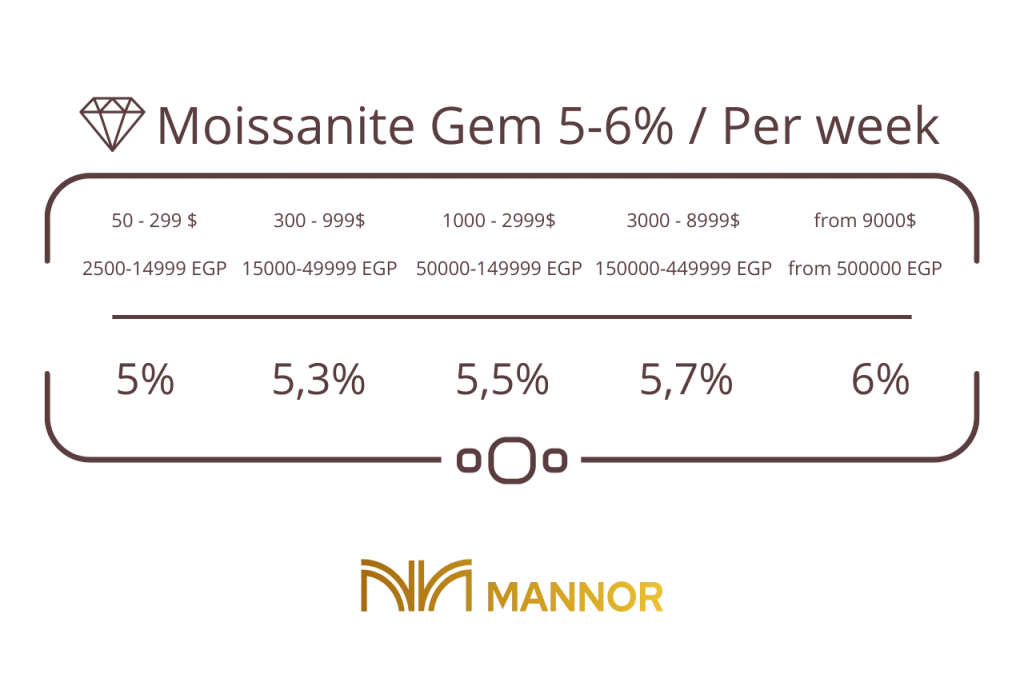
MoneyBack is credited weekly through the Mannor Jewelry loyalty program.
Not once. Not “someday later.”
Week by week, according to the published rules.
The key figures are defined upfront:
- up to 6% per week
- up to 312% total MoneyBack
- across a 52-week cycle
No floating conditions.
No hidden mechanics.
No mid-cycle changes.
This level of clarity is not accidental – it’s how Mannor Jewelry positions the system from the start.
Why 312% at Mannor Jewelry Isn’t “Magic” – and Definitely Not the Market
This is the point where skepticism usually peaks.
A number like 312% immediately triggers associations with speculation, volatility, or aggressive risk. That reaction is normal.
But the Mannor Jewelry MoneyBack model isn’t built on any market mechanism.
Funds are not circulating on exchanges.
There is no exposure to asset prices.
Nothing depends on crypto charts, gold rates, or macroeconomic swings.
Mannor Jewelry also doesn’t frame this as “fast money.”
In fact, people who come looking for instant results often lose interest quickly.
“This is not for anyone chasing x2 in a week.”
That’s not a disclaimer – it’s simply reality.
What Mannor Jewelry offers instead is a fixed-cycle system:
- a clearly defined duration
- predictable weekly accrual
- a capped maximum return
You always know where you are in the cycle.
You always know what comes next.
There’s no “wait and see” phase.
No moment where outcomes suddenly depend on external conditions.
From the outside, this can look almost boring.
But for people who value understandable systems – ones that can be explained without jargon and tracked week by week – the Mannor Jewelry model feels unexpectedly calm.
And that’s usually when the real question changes.
It’s no longer “Is 312% real?”
It becomes “Do I prefer a system I can fully understand from day one?”
That’s where mannorjewelry.com tends to resonate most.
Who This Format Really Fits – and Who It Doesn’t
This is where it makes sense to pause and be honest – especially when talking about a specific system like the one used by Mannor Jewelry.
This format isn’t universal.
And Mannor never positions it that way.
It works best if you were already considering buying jewelry. Not because you were “looking for a MoneyBack system,” but because you genuinely wanted a piece you’d wear, keep, or gift. In that case, Mannor’s approach doesn’t force a financial decision – it simply adds a smarter layer to a purchase you planned to make anyway.
It also fits people who feel uncomfortable with the idea that a purchase dies the moment the payment goes through.
If you’ve ever thought, “I’m fine paying for quality, but I hate that it just ends there,” the Mannor Jewelry MoneyBack model tends to resonate. The purchase doesn’t stop at checkout – it continues within the loyalty system.
Long-term thinkers usually feel at ease here.
Not people chasing speed, but those who understand cycles. Weekly returns — even relatively small ones – don’t feel slow to them; they feel structured. With Mannor, there’s a rhythm: week by week, the process unfolds without surprises.
That rhythm is part of the design.
On the other hand, Mannor’s format clearly isn’t for everyone.
If you’re looking for trading, speculation, or fast flips, this isn’t it. Mannor Jewelry doesn’t offer charts, leverage, or timing strategies.
If you dislike discipline, cycles, or fixed rules, the Mannor MoneyBack cycle will feel restrictive. It doesn’t adapt to emotions or impatience.
And if you don’t want to understand how something works – if you prefer blind participation – this model isn’t a good match either. Mannor’s system quietly expects clarity and awareness from the client.
That’s not a weakness.
It’s a built-in filter.
Why Moissanite Fits the Mannor MoneyBack Model Better Than Anything Else
Here’s the connection that often gets overlooked.
Yes, Mannor Jewelry offers MoneyBack on different types of jewelry:
- gold pieces
- silver pieces
- and moissanite-based jewelry
But moissanite stands apart within the Mannor system.
The reason is not marketing – it’s structural.
Moissanite offers one of the best ratios between visual effect and production cost. Compared to traditional gemstones, it requires less labor-intensive extraction and processing. From a production standpoint, moissanite jewelry is simply more efficient.
That efficiency matters.
Because less cost is locked into raw materials and manual labor, Mannor Jewelry can allocate a higher MoneyBack percentage to moissanite pieces. This is why moissanite jewelry carries the highest MoneyBack potential within the Mannor program.
It’s not arbitrary.
It’s economic logic.
There’s also a lifestyle factor.
Moissanite isn’t intimidating to wear every day. Clients don’t hesitate before putting it on. Mannor’s moissanite designs work especially well in modern, minimalist, and contemporary styles – jewelry meant to be lived in, not hidden away.
That combination – production efficiency + everyday wearability – makes moissanite the most rational choice for a long-term MoneyBack cycle at Mannor Jewelry.
Important Nuances Worth Understanding Before Choosing Mannor
This is where real trust is built.
MoneyBack at Mannor Jewelry doesn’t arrive instantly. There’s no “buy today, earn tomorrow” illusion. The program works through a defined 52-week cycle.
The return is not a linear cashback either. It unfolds gradually, week by week, according to Mannor’s fixed loyalty logic. Some weeks feel more noticeable than others – and that’s part of how cycles work.
Most importantly, the Mannor MoneyBack program only makes sense if you understand the conditions before purchasing. Knowing the timeline, the limits, and the structure isn’t optional – it’s part of making an informed decision.
Nothing is hidden.
But attention is required.
Final Thought – Not About “Earning,” but About Choosing Well
Moissanite on its own is already a smart alternative to diamonds. Durable, visually striking, and practical for everyday life.
But when combined with Mannor Jewelry’s structured MoneyBack system, it becomes something more.
It remains jewelry.
It can function as an asset.
And over time, it may become a source of regular return.
Not because of hype.
Not because of speed.
But because of structure.
Sometimes, a truly smart purchase isn’t about getting a discount upfront.
It’s about what happens to your money after the purchase is complete.